Wednesday, 14 September 2016

20- Spain: From the frying pan to the flames

A few more flights, a few more steps closer to home. You know you’ve been travelling for a long time when your reflex in the bathroom is to look for the bin to put the toilet paper in! You mean we can throw stuff in the toilets again? Wow. And can we drink the water that comes out of the tap? Yes? The wonders of the world. How we forget how the other half lives! And with that introduction we arrive to the tap water drinking, sewerage working, toilets flushing utopia that is Spain. Welcome to paradise! 

First stop in lovely Espana was to the coastal town of Calpe, an hour from Malaga. We were there to bear witness to the phenomenon that is “two accountants who trained together in Deloitte Cork, then moved to Australia and then came back to Europe to get married”- these two certainly sound like they tick all the boxes! Good on them. We had a lovely couple of days relaxing and de-jet lagging around Calpe before the big day which was nice. The day itself was super as we were shuttled around the area and treated to a wonderful day and night out.

After the hospitality of the wedding, it was time to don the backpacks once again, or wheel them whichever you prefer, and head north as we hopped on the Spanish high speed train, the Ave (as in Ave Maria!) and headed to Barcelona. It’s a really super train system. Similar to Japan and definitely the best we’ve come across outside of there.

Barcelona itself is a very funky city and certainly lives up to its huge reputation as one of the coolest around. With heaps of arty monuments and buildings, as well as a wide variety of food, there’s a huge amount of things fighting for your attention. All of the cities highlights are well worth visiting with Park Guell, La Sagrada Familia cathedral, La Boqueria market and the Nou Camp all being great entertainment. The Nou Camp, the home of Barcelona FC is a good few hours. We’ve done a few tours like this before. This one took the mythmaking to whole new levels as they really pushed all their players past and present to deity level. Amusing the propaganda that’s written around the place- North Korea would be proud of some of it. I suppose somebody has to be employed to write the stuff. I was very impressed though when you get to the pitch they’ve actually covered over a bunch of seats for the summer and built a pitchside bar/ café. Having a coffee pitchside was a nice cherry on top of the tour.

Heading to the Boqueria market was a right treat. So much gorgeous food, I came very close to drowning on my own drool. Thankfully it didn’t come to that and we just had lunch instead!

It seems incredible that Barcelona has a population of just 1.5million people but attracts 7.5 million tourists a year. That’s 5 times the population, incredible. In comparison Ireland as a whole got 7 million tourists last year. Popular spot indeed.

From the Catalan capital we moved across to the official capital, Madrid to enjoy a few days there and celebrate one year of marriage. It’s being a pretty hectic year all things considered; amongst other things we’ve visited 21 countries in 12 months- not a bad return. We’ll be hard pressed to keep that pace up!

Madrid was great for the few days. It’s a royal city so similar to London in many ways with loads of palaces and royal monuments. Good to stroll around but the real delight we found was the tapas tour you can do. Madrid has a huge amount of tapas bars, so many that it is an appealing pastime for tourists to make their merry way from one bar to another, for a night getting merrier and merrier while doing it! A great way to spend some time sampling different tapas and pinxtos in various cafes while washing them down with some cheap Spanish drinks. What’s not to love about it.

From the royal capital we moved to the Catholic capital and got to Seville where we began to realize that the thermometers in Spain must be broken. It was very hot in Barcelona and Madrid, in Seville we began to realize why the Spanish invented siestas! The mercury was rising and so was the number of rest stops and drink stops we were taking just to get some shade. The delights of a Spanish summer.

Seville was quite a revelation to us. A really gorgeous city, lots of cathedrals, beautiful buildings, super food. Oh the food. Spain as a whole has a given us some of the best food of our trip. Just beautiful. It would be the number one reason why we’d go back there. 

Our final stop of the eight months was to the frying pan of Spain, Cordoba where we were the weather gave us a volcanic-like greeting and my sister and her family gave us..... a wonderfully warm welcome! 45 degrees to hit while we were. Amusing to be around the city in that temperature and realise that the only people out and about are tourists! All the locals are far too sensible to be anywhere outdoors in that temperature.

So after eight months on the road, we come to an end. We left our Australian family in October and our final stop was to our Spanish family- a fitting end and one that we arrived at reluctantly. 

"Are you sure we can't go on? Ah go on, just another few months?!?! Are you sure? Last chance....."

Our trip from Melbourne to Cork with many, many stops along the way is at an end. It’s been the most amazing adventure, one that we will never forget and hopefully one day we’ll hit the road again and add to these stories.

With heavy hearts we end our trip but we have many memories, over 12,000 photographs and 20 blogs with us for company, it’s time to unpack those boxes we shipped………

Click here to see a selection of photos from our Spanish trip

Our route:
Fly to Alicante, trains to Barcelona, Madrid, Seville, Cordoba, fly Malaga to Cork

Our overall route:

Australia, Sri Lanka, Malaysia, Singapore, Japan, Philippines, Hong Kong & Macau, New Zealand, Chile, Bolivia, Brazil, Colombia, Guatemala, Belize, Mexico, Cuba, USA, Spain, Ireland

Monday, 22 June 2015

19- America: Welcome to Chi-town

I haven’t looked up the exact definitions but I’ll make a guess and say that our arrival to Chicago signaled us returning to first world countries for the first time since New Zealand in February- apologies South and Central America if that’s not true. It definitely signaled our return to English speaking first world countries, how about that? Funny how many times we were in Chicagoan cafes or restaurants and without thinking said “gracias” to the wait staff! It becomes reflex and sure who’s really to say that we’re not part Mexican or Colombian!?

Chicago is a really cool city. It was our choice of stopover on the way back to Europe to visit friends, Kyra and Peter, who’d emigrated there so they provided us with swanky accommodation in a 46th floor city centre apartment. Sweet as. There’s a lot to do within the city itself and we were kept fully occupied for the five days.

Our introduction to Americans came at the airport where at passport control we were talking to an Officer Ramsey- I’m not going to say he was a stereotypical American but he certainly managed to turn himself into some sort of clichéd version of what foreigners think of Americans. Why would any American officer of the law have a problem with two law-abiding citizens such as ourselves? Well, the problem stemmed from the fact that we hadn’t lied on our entry form- we were asked to list where we had been beforehand on this trip and included Cuba in our (longwinded) answer. Officer Ramsey was none too impressed. The general gist of the conversation went as follows:

Ramsey: You know it’s illegal for American citizens to go to Cuba?
McCarthy: Yes, but we’re not American citizens
Ramsey: There are 12 reasons for American citizens to be allowed to enter Cuba and you have to go through a strict process in order to be allowed to visit that country
McCarthy: Yes, but we’re not American citizens

(at this stage he began looking over both shoulders for someone to assist him, presumably to confirm to him that there are in fact people in the world who are not American citizens)

Ramsey: This is going to be a problem
McCarthy: What’s going to be a problem?
Ramsey: It’s illegal for American citizens to go to Cuba
McCarthy: Yes, but we’re not American citizens

(continues to look around for help. At this stage he still can’t find anyone so  flicks through all the passport stamps)

Ramsey: What do you do for a living?
McCarthy: We’re accountants

(He seemed disappointed, not sure was this a trick question where he was hoping for “Communist sympathizer” as the answer)

Ramsey: I suppose I can let you through because you’re not American citizens but you’re going to get a lot of hassle from the Customs guys
McCarthy: Why?
Ramsey: Have you brought stuff from Cuba with you? Cuban cigars, rum etc
McCarthy: Yes, but per the US Customs website we’re allowed bring $100 worth of goods into the country
Ramsey: I KNOW THE LAW
(At this stage I looked over my shoulders to confirm I wasn’t on a TV show and then relook at Officer Ramsey to see if he’s auditioning for a scene in “A Few Good Men”!)

Ramsey: When did you look up this website?
McCarthy: Yesterday

(Not sure if he thought that non-American citizens spend significant time reviewing old US laws but anyway….)

Ramsey: Well you’ll have to prove how much they’re worth. Do you have receipts or credit card statements?
McCarthy: No they’re from Cuba. They don’t really do receipts or credit cards.
Ramsey: Well that will be a problem for the Customs guy. The Customs guys will take everything out of your bags and ask you loads of questions because you’ve a lot to explain. They’re really going to grill you.
McCarthy: That’s fine, they can have the cigars if they want them.
Ramsey: Right, go ahead to Customs

(Stamps passport)

We then proceeded to walk through customs without anyone looking anywhere near us! Happy days, the Cubans cigars are in the country! Thankfully we didn’t meet any more Officer Ramsey’s and had a lovely time with all the other Americans we met and even more so with the Irish Americans we were visiting! 

After the meet and greet was done, we set about exploring the city, a city I didn’t know much about but you get a sense of déjà vu when you walk around either because I lived here in a past life or it features heavily as a backdrop of so many TV shows and movies. Even if we didn’t get to meet Dr. Mark Green from ER or any other characters, we did get to see the L train and the tracks which weave in and out of the city, above ground, below ground, through buildings, over roads, over rivers, over bridges. It’s really amazing to see it. So while the L is a main character weaving around Chicago, its what it weaves around is the real highlight- skyscraper after skyscraper. The best way we found to get to know these skyscrapers was by taking an architecture tour through the city. The tour is two hours and is a boat ride down the river to Lake Michigan while taking in all of the amazing buildings all round. Really different to any other tour we’ve done and well worth it.

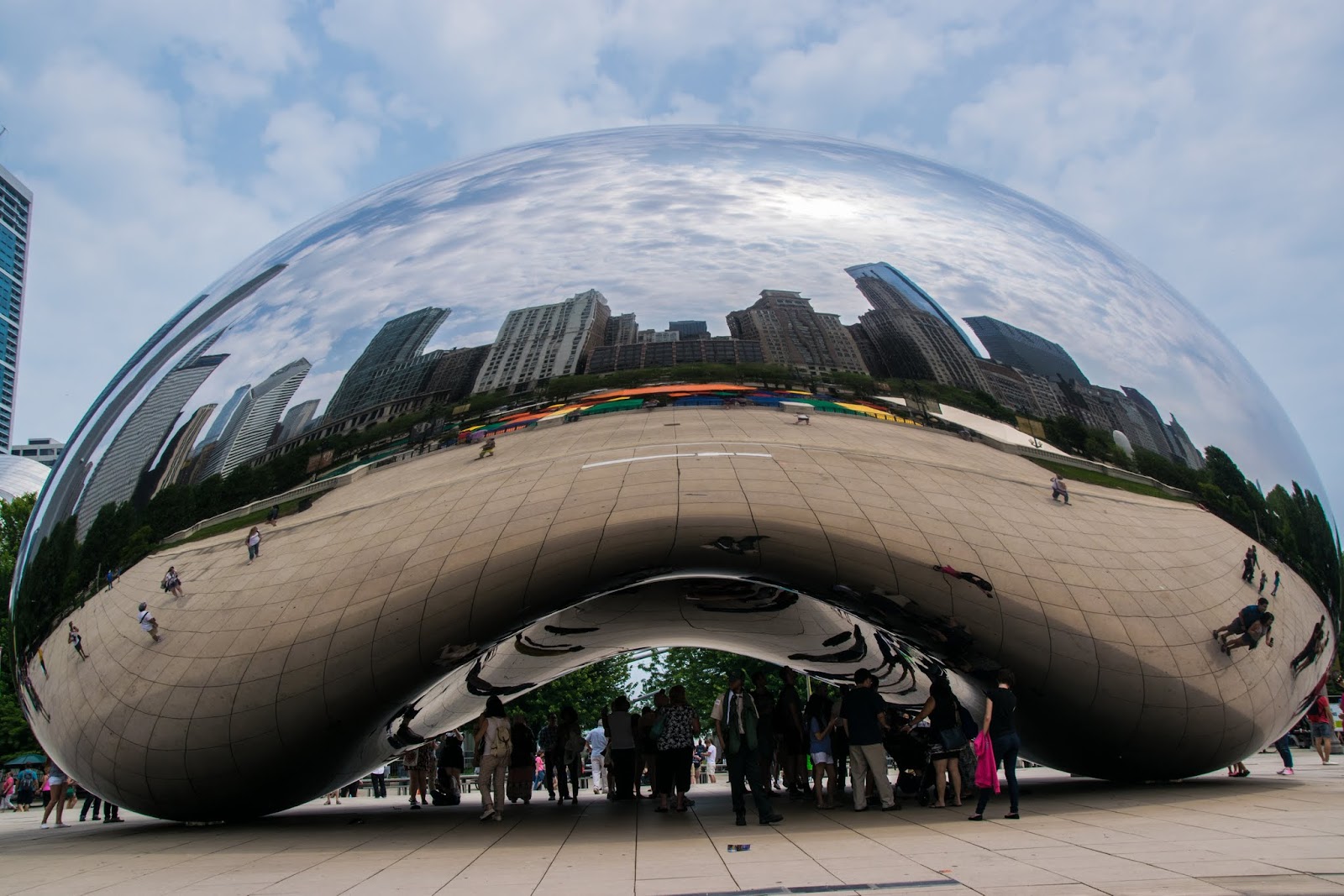
Speaking of amazing, the picture shows "Cloud Gate" which is a sculpture erected in Millennium Park in Chicago in 2006- more affectionately known as "The Bean". On a sunny day like we had, you can spend ages walking around or under it, as the reflections of the city bounce off it. Very cool. Lots of time to be spent trying to get that perfect photo! 

Another touristing highlight of the city was a day spent cycling around it. They have the city bikes which cost $7 for a day and once you switch bikes every half an hour that’s all you get charged. Very flat city so easy to do and gave us a chance to visit lots of other areas of the city around Lake Michigan including Lincoln Park, Navy Pier and Soldier field football stadium. They have a really good zoo inside in Lincoln Park too which was a nice bonus- loads of really cool animals inside and things are always better when they’re free!

One thing that still confuses us having left the country is how to navigate your way through eating or drinking out in America- so fricking confusing:
  • You add on tax to what was on the menu
  • You must add on a tip
  • What should we tip though?
  • I’m positive 15% was a good tip last time I was in American, now it’s 20% minimum. Weird
  • Is the same for all meals? How about drinks?
  • So should the tip be calculated before or after tax?
  • Does the standard of service even matter?
  • What should we be getting for this 20%?
  • How much do wait staff earn? They seem to get an awful lot of money for doing very little
  • Does the restaurant, café or bar pay these people anything? What an amazing business model on their part- genius altogether! 

All very confusing, basically it means that until you hand over the cash you’ve no clue what you’ve spent! How they could possibly think this is a good system is beyond me!?

We had good timing in our arrival to Chicago with their ice hockey team, the Blackhawks, playing in the Stanley Cup final. Great atmosphere around the place with posters up everywhere, buildings lit up in red at night and obviously the bars full for the games. Last night in Chicago, the four of us headed to Second City comedy club- highly recommend it as a stopping point. Sketch after sketch for a few hours, absolutely hilarious. It’s a famous club because a load of celebrities started their careers here- Dan Ackroyd, Tina Fey, Stephen Colbert, Steve Carrell, Bob Odenkirk (Better call Saul), Mike Myers, Dan Castellaneta (Homer Simpson himself) and load of others. Should be very high up on any to do list for Chicago and was a great way for us to finish off our few days.

Great hosts certainly help to make a visit to any city worthwhile and with great accommodation so centrally located along with more food, drink and tour information then we knew what to do with, it all helped to make for a great few days. 

And so with the Windy City visited, clothes for the wedding in Spain purchased, it was time for one the penultimate flight. With heads down, we got through airport security without meeting Officer Ramsey one more time. Better to be safe!

On we go, Vive Espana…….


Our route:

Fly to Chicago, fly to Alicante, Spain

Sunday, 14 June 2015

18- Cuba: Rum, cigars and 1950’s cars

Out of all the countries we’ve visited, Cuba is the one that seems to hold the most intrigue for people. Spending fifty years in the international wilderness and seemingly stuck in a time warp will do that to you. When we told people we were going there, people always answered jealously and of course made the obligatory remark that it’ll be great to go there before the Americans ruin it!

We too were intrigued by the place and when we were queuing to check into our flight from Mexico City, it became very clear that this was not a regular place we were going to. I had noticed on receipt of our flight tickets that the baggage allowance was an unwieldy 50kg. I didn’t give it much thought besides being amused by the unusual generosity of a communist regime to baggage allowances. When we joined the queue for the flight, we begin to understand why- as tourists queued with their sensibly sized bags approaching the 20kg mark, all of the Cubans, thankfully in a separate queue, appeared to have just come to the airport having cleaned out several Harvey Normans! How many flat screen TVs does one person need? Every one of them looked like they had a minimum of 5 packages all containing the latest in technology which clearly was not available in Cuba- trips to Mexico are obviously shopping sprees for Cuba’s nouveau riche or returning expats.

To top off the surreal check in process- we had a novel meeting with a Cuban man trying to make friends. Why? He was looking for someone to bring a package for him to Havana- a mule of sorts you might say! Clearly the guy hadn’t seen “Banged up Abroad” as he wasn’t having much luck with his not very enticing request. So even before we had set foot in the country, the Cubans were proving to be a different sort of breed altogether. We were already entertained!

The majority of postcards you see of Cuba all revolve around the cars, a very unique thing to Cuba. It didn’t take very long for us to see exactly what all the fuss was about. The 1950’s never left here and the cars are the real indicator of this. There are loads of other things that are stuck in the 50’s but the cars are the ones that stick out like a sore thumb. Every street is an antique car rally. Wherever you look, a car that has no right to be still working chugs past you. The more you look around, the more we fell in love with them. They really don’t make them like they used to. These cars are huge. So long, so sleek, so very cool.  In lots of cases, the cars will drive past and leave you a present of a nice cloud of black smoke- they can keep them running but they can’t make them any better for the environment!

It’s funny; all the postcards that you’ll see have the sleek convertibles, the flashy cars that are still around the place. No place on the postcards for the array of junk cars that are still around. I haven’t seen a Lada in a long, long time. The Soviet Unions finest is in full flow on the streets of Cuba but neglected in the postcards- I can’t imagine why! Even if trade opens up the flashy cars will be here for a long time as a tourist attraction if nothing else. Currently being used for everything and anything but the tourist attraction is where the money is at. It didn’t take long for us to decide to take a tour of Havana in one of them. Deciding what type and colour car we would take was the one that took the time to figure out! As city tours go, taking one in Havana sunshine in a 1957 orange convertible Ford Fairlane is a pretty good way to go- sure beats the bus!

So with our friend who owned the 58 year old car as guide we were shown around Havana. For a city of 2 million people, it comes across much smaller. Certainly the lack of traffic helps that impression. You do have lots of people on the streets, just hanging around chatting or using the payphones. Seemingly not doing much most of the time but who are we to judge! It didn’t matter what time of day it was, any bank of payphones that we saw were always being used. So strange to see but then you have to bear in mind that it was illegal for anyone to purchase a mobile phone before 2008. Different world. So it really is the little things that you see around the place that makes it so intriguing from the black market sellers to rickshaw runners to street sweepers smoking big fat cigars. You never know what you’ll see. Take our first day as an example, walking through Havana on a Saturday afternoon and we heard raised voices ahead as an argument was going on between two men- a few steps on we realized that one had pulled out a machete and the other guy was defending himself with a large plank of wood! Lots of onlookers trying to calm the situation but we chose not to be included. In my mind it all ended amicably and they shared a bottle of rum afterwards. You never know what you’ll come across in this place.

With Cuba as it currently stands, its not one thing that intrigues you or one thing that makes you laugh, its literally everything here that bamboozles you. It delights you and it frustrates you at the same time. Even the simplest things can lead to frustration. Something that you thought would take you five minutes ends up taking an hour but at the same time you find yourself taking a deep breathe and reminding yourself that there’s no place else like this. The modern westerner will no doubt proclaim “Thank God for that”. When I refer to small things- that could mean “I want to buy a bottle of water”, no point in starting with the more difficult queries like “I want to buy toothpaste”! You see, Cuba really doesn’t have shops. I don’t mean shopping malls or supermarkets either I mean shops. You can be in the main tourist area and still struggle to find out where to buy the most basic things. The fact that the licenses for shops seem to restrict the sellers to only specific goods obviously doesn’t help. When you do find shops, quite often you’ll walk through and see that the majority of shelves in the shops are empty. Seriously, how these people manage to cook a coherent meal still amazes me. If you ever doubted that the Cubans were in a time warp then a visit to a furniture shop is a must. There you will find a whole array of furniture decked out in floral patterns that surely went out of fashion in the very early 60’s- they’re actually probably so old that they’ve probably come back into fashion as retro designs numerous times! It is a window into a Cuban living room- speaking of which….

As we’ve mentioned Cuba does many things differently to the rest of the world, another thing to add to the list is their accommodation. Here there are hotels, not many of them, and there are no hostels- the main type of accommodation you have are “Casa Particulares”- in most cases this is simply renting a room in someone’s home, effectively AirBNB without the fancy website. The joy of this is that you get to spend time in the home of Cuban families, see how they live, avail of their hospitality and in many cases eat your food there. We stayed with a number of wonderful families who were so welcoming. Communication was a struggle at times given our Spanish speaking abilities but you always got through. The breakfasts they served were better than any we’ve had anywhere else. Superb. We wouldn’t need to eat for the rest of the day. You’d assign at least an hour for it as the food tended to just keep on coming. You really felt like you were the prodigal son coming for a visit. This linked with what I just said about the shopping made it all the better. Served the freshest fruit and some of the best coffee I’ve ever had. The joys of them not being able to export their good stuff!

Obviously you need to take the good with the bad, the good was described above, the bad is actually trying to book and find the places! I will never take for granted the ease with which you can book accommodation online again. Presumably due to trade restrictions none of the established booking websites operate in Cuba so you are forced to use Cuban based ones. It’s a tedious process as availability of accommodation isn’t shown on the site and every casa particulare has only one maybe two rooms so there are hundreds to choose from with no clarity as to which are good and which are not, which are available and which are not. Oh how we take the internet and its wealth of information for granted. There’s no connectivity in the country either besides in a few 5 star hotels. The basic things again are out of reach- using the internet to book accommodation, directions to places, confirmation emails, the random questions you put into Google- no longer possible! But these fun struggles are always what we’ll remember, booking something with three clicks on Hostelworld isn’t that memorable. “Cuba gives you memories”- there’s one for their tourist posters!

From Havana we went west to Viñales, one of Cuba’s most scenic regions- an area famed for its cigar manufacturing. On the journey through the countryside to get there, we spotted lots of billboards along the road. However none of them carry conventional advertising, all of them are covered with some sort of political message and generally contain images of one of the Castros or of Che Guevara. The favourite one I saw was one, which combined three pictures- one of Hugo Chavez of Venezuela, the second featured Fidel, himself and the third randomly featured Nelson Mandela! I don’t know what the caption was but I’m sure the family of Nelson Mandela didn’t sign off on the poster!

While in Viñales, we did a tour to give us an idea of the manufacture of cigars. I’m not a smoker but the whole thing is amazing. All done by hand. Over a hundred different processes involved in making the cigars. We visited a farm where the tobacco is grown. There we met the farmer, a right character, who greeted us with rum and cigars he rolled himself. At ten in the morning it was a great start to the day. They say smoking’s not cool, well I respectively disagree- when it’s a cigar that big, how can you not look cool! So after seeing the beginning of the process we were then brought to various factories to see more of the processes. Our favourite part was in the cigar factory where the finishing touches are put on- such delicate work. Depending on the size of the cigar each worker must do a minimum of 100 cigars a day and they then get paid extra if they go above their quota. They also get to keep two cigars a day for themselves- perks of the job! Our tour guide assured us that most of these freebies would find themselves on the black market and sold for much more then what their wages were. Meanwhile in a booth In the corner they have a guy employed who’s job is to read to the workers from a book over a microphone all day long. Todays book of choice was by Che Guevera! Oh the entertainment.

From Viñales, we moved east again to Trinidad, another place caught in a timewarp only this time the timewarp began in the 1850’s not the 1950’s like Havana. Lots of really old buildings, lots of cobblestones, lots of horse and carts. Charming place where we spent time walking through every street in the place. The pace of life here makes Havana seem like Manhattan! Funny to see the horses tied up against the front gates of the houses. Here having a car from the 1950’s puts you well ahead of the game! 

Another of the many strange things about Cuba is the fact that it has two currencies, not in the way that many European countries did while they transitioned from their old currency to the Euro, but they actually have two operational currencies and to complicate it further neither currency is convertible in FX markets outside of Cuba! Basically, tourists and middle/ upper classes in Cuba have access to the CUC while the peso is the currency used by the majority of people. 1 CUC is worth 25 times 1 peso. These two currencies have unintentionally resulted in a two tier society- those who can get access to the CUC and those who can’t. The link to us is that for those Cubans who are not rich, the easiest path to get access to CUCs is through tourism. So you get to a system where all government workers are paid in pesos which isn’t much so everyone is now striving to work in tourism- for example a taxi driver who gives 3 trips (to tourists of course) from Havana airport to Havana will earn more then what a doctor earns in a month! It’s all very strange and it really results in tourists paying way over the odds for everything as we have no access to the cheaper currency! For comparison, we found Mexico a much cheaper country to travel in. As far as we could see, there were no benefits to this system and there’s a reason nobody else has two currencies. The sooner they get rid of this, the better for everyone!

As we felt we hadn’t maximized the communist part of our trip, our next stop was to Santa Clara or as I like to call it, the town that loves Che Guevara the most! The reason behind the love is, this was where one of the most important victories of the rebellion took place led by Che Guevara himself- it involved a digger wrecking the tracks of the train line to stop the train containing military supplies getting to Havana. Amusingly enough the same digger now sits atop a pedestal in an open air museum right next to the train carriages involved- best museum ever! The town also has a number of statues of him and any number of paintings and murals of him. Popular man around here although having heard differing views as to his actual popularity, seemingly due to things he did once he got power, it seems that more reading will be required by me to actually understand where he lies or should lie in their history.

And so after two weeks of trekking around Cuba as the locals see it, we spent our final few days in Cuba as the tourists see it! Varadero is a town built around its sandy beach where ever since the 1990’s lots of beach resorts have been built - three days around pools, beaches and all-inclusive bars and restaurants- surely the exact opposite of what the Castro’s fought for! Anyway, we check the politics at the door and head for the buffet………!


Our route:

Fly to Havana, bus to Viñales (day trip through Viñales valley and Pinar del Rio), bus to Trinidad, bus to Santa Clara, bus to Varadero, bus to Havana, fly to Mexico City